
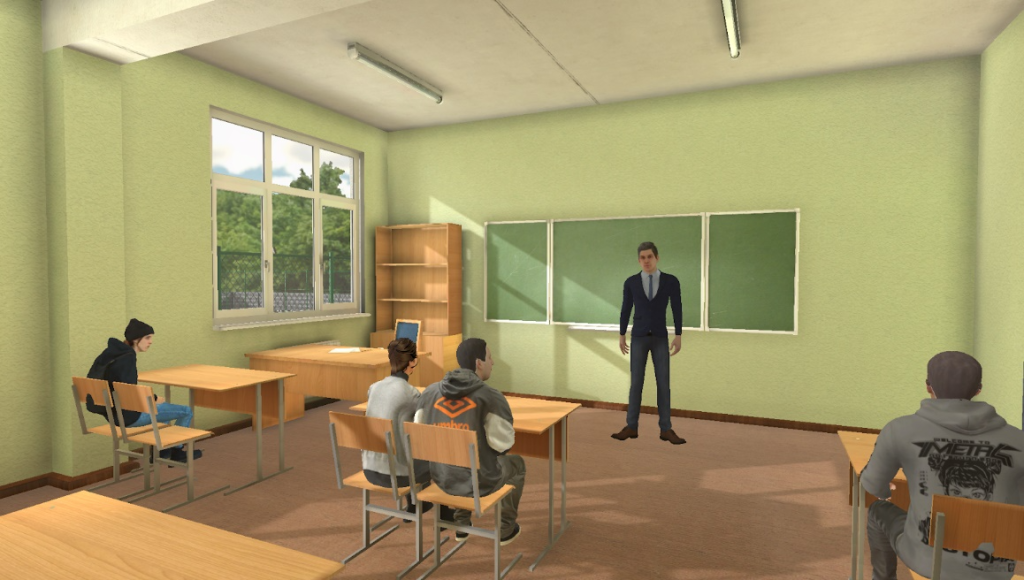
Leveraging our deep experience in immersive learning tools, we built a virtual-reality simulator that teaches students and staff how to act during critical incidents—fire, flood, severe weather, or intrusion—inside a digital twin of a school.
• Drill rapid, correct reactions to multiple emergency scenarios.
• Cut training time and expense vs. live drills.
• Gauge readiness of pupils and staff; surface skill gaps.
• Lower the risk of injury or loss of life.
Solution
1. Plug-and-play experience
– Runs on a standalone VR headset; no extra hardware.
– One-click launch from the device menu.
2. Multi-scenario library
– Threat types: fire, hurricane, flood, armed attack.
– Users pick both the incident (e.g., fire) and the location (classroom, gym, cafeteria).
– Realistic visuals and physics reinforce muscle memory.
3. Built-in safety protocol guidance
– Dynamic prompts: stay low in smoke, hold hands, breathe through cloth, keep right on stairs for firefighter access, follow exit signage, assemble at muster point.
– Instructor avatar leads evacuation; HUD displays key actions.
4. Performance analytics
– Post-session score auto-exports to the school’s LMS.
– Administrators see strengths, weaknesses, and training history, enabling targeted remediation.
Business Impact
• Dramatically higher student engagement vs. lecture-only methods.
• Up to 90 % reduction in errors during drills, according to pilot metrics.
• Quantifiable improvement in emergency readiness across staff and students.
Business Impact
• Dramatically higher student engagement vs. lecture-only methods.
• Up to 90 % reduction in errors during drills, according to pilot metrics.
• Quantifiable improvement in emergency readiness across staff and students.
Project Facts
Team: 5 (backend + 3D generalists)
Measured outcome: 90 % risk reduction

Copyright © 2024. All rights reserved by UplineSoft Inc.
